


Why Small Wastewater Plants Still Choose Roots Blowers
For wastewater treatment plants handling less than 20,000 tons per day, blower selection is rarely about peak efficiency alone. Operators often need stable aeration, manageable maintenance, and a practical payback profile. Against that backdrop, Roots blower wastewater treatment remains a strong choice because the equipment has a simple structure, adapts well to variable liquid levels, and supports dependable operation in small municipal and decentralized facilities.

Why Variable Liquid Levels Change the ROI Equation
In biological treatment tanks, water depth directly affects outlet pressure. When the liquid level rises, the blower must overcome higher back pressure; when it drops, system pressure decreases. A Roots blower has a relatively stable pressure–flow performance curve, so airflow changes only slightly when outlet pressure varies. This makes Roots blower wastewater treatment especially suitable for variable-liquid-level systems that need narrow airflow adjustment without overly complex controls.
For small plants, this stability matters. Aeration supplies oxygen for microbial activity in biological contact oxidation and related treatment processes. If airflow fluctuates too much, treatment performance becomes less predictable. A Roots blower helps maintain a steadier air supply even when inflow and tank level are not perfectly constant.

Practical Advantages in Small WWTP Operation
One major reason Roots blower wastewater treatment performs well in smaller facilities is mechanical simplicity. Compared with centrifugal alternatives, Roots blowers are widely recognized for straightforward structure, smaller daily maintenance workload, and lower repair or replacement cost in typical small-flow applications.
There is a clear trade-off: under constant-pressure operating conditions, Roots blowers may be more than 10% less efficient than centrifugal blowers. However, plants below 20,000 tons per day often face variable loads, limited maintenance staffing, and tighter project budgets. In these cases, lower initial investment, easy servicing, and reliable adaptation to pressure changes can deliver a more balanced lifecycle return than efficiency figures alone suggest.
Belt Driven or Direct Coupled Selection
In Roots blower wastewater treatment, configuration should match the operating environment. Belt-driven units allow the main shaft speed to be adjusted through the pulley ratio between the motor and blower. This gives manufacturers and users more flexibility across airflow and pressure combinations, and it is often preferred where routine maintenance access is important.
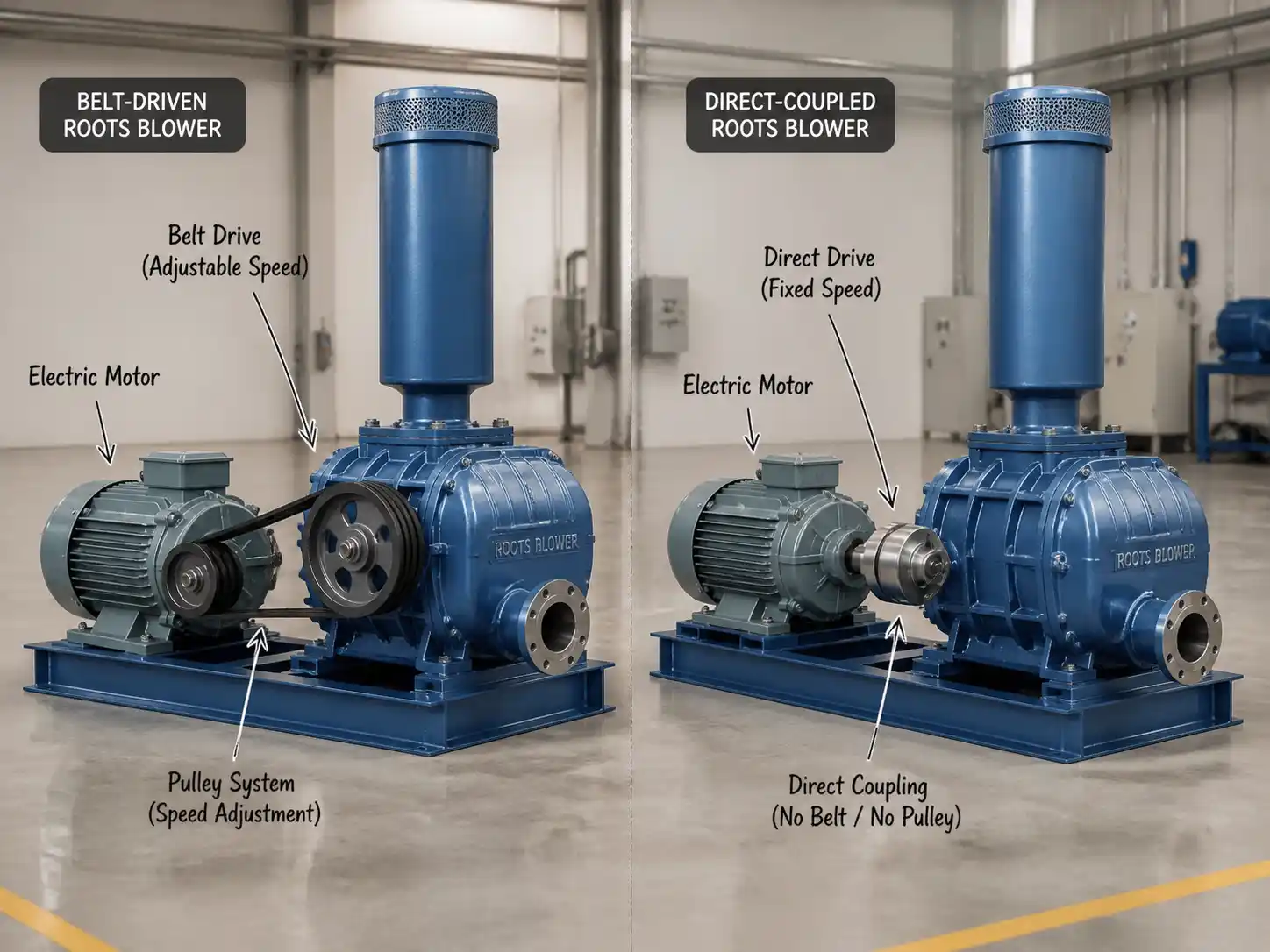
Direct-coupled units run at a fixed speed, with the blower shaft speed matching the motor speed. They are commonly selected for special operating environments, such as high-temperature working conditions where belts may slip or break, or static-sensitive conditions where ordinary belts are not suitable. If no special condition applies, belt-driven designs are often selected because maintenance is relatively simple.
Selection Checklist for Better Payback
Before purchasing an aeration blower, engineers should avoid sizing only for a theoretical peak point. A practical Roots blower wastewater treatment selection should evaluate:
- Required airflow based on process oxygen demand
- Outlet pressure from water depth, pipe resistance, and diffuser conditions
- Expected liquid-level changes in the aeration tank
- Maintenance access and operator skill level
- Whether belt-driven or direct-coupled configuration better suits the site
Oversizing is a common mistake. A blower that is too large can increase energy use and make airflow control harder. Ignoring liquid-level variation is another frequent issue, because actual back pressure may differ from the design point during daily operation.
Maintenance That Protects Lifecycle ROI
The economic value of Roots blower wastewater treatment depends on disciplined maintenance. Simple equipment still needs regular observation. Operators should check lubricant level after initial operation, replace lubricating oil after 500 hours for the first change, and then follow scheduled replacement at about every 4,000 operating hours.
Routine checks should also include vibration monitoring at bearing positions, listening for abnormal noise, tracking temperature at the bearing boxes, casing, and motor bearings, and observing motor current. Abnormal current, excessive temperature, irregular noise, or rising vibration can indicate installation issues, overload, poor ventilation, dirty inlet filtration, or mechanical wear. Early attention prevents small problems from turning into unplanned shutdowns.
Conclusion
For facilities below 20,000 tons per day, Roots blower wastewater treatment offers a practical ROI path: stable airflow under changing liquid levels, simple mechanical construction, flexible configuration, and manageable maintenance. Centrifugal blowers may deliver higher efficiency in stable, large-flow conditions, but small wastewater plants often value reliability, adaptability, and lower service complexity just as highly. When airflow and pressure are calculated carefully, a Roots blower can be a cost-effective aeration choice for real-world small plant operation.
FAQs
Why are Roots blowers used in small wastewater plants?
They provide stable airflow when outlet pressure changes, have a simple structure, and require relatively low daily maintenance, making Roots blower wastewater treatment suitable for small municipal wastewater treatment plants.
Are Roots blowers always more efficient than centrifugal blowers?
No. Under constant-pressure conditions, centrifugal blowers can be more efficient. Roots blowers are often chosen in small plants because they balance airflow stability, maintenance simplicity, and investment cost.
How does liquid level affect blower selection?
Changing liquid level changes back pressure. A Roots blower’s flow changes only slightly with outlet pressure variation, which supports stable aeration in variable-level tanks and makes Roots blower wastewater treatment more robust in day-to-day operation.
When should a direct-coupled Roots blower be considered?
Direct-coupled units are often considered for high-temperature or static-sensitive environments where ordinary belt transmission may not be suitable.
What maintenance items are most important?
Lubrication, vibration, abnormal noise, temperature, and motor current should be checked regularly to reduce failure risk and protect long-term ROI in Roots blower wastewater treatment systems.
References
- Shandong Zhangqiu Blower Co., Ltd. (2019). Industrial wastewater treatment and aeration blower application.
- Shandong Zhangqiu Blower Co., Ltd. (2019). Maintenance of Roots blowers for wastewater treatment aeration.
- Shandong Zhangqiu Blower Co., Ltd. (2019). Roots blower selection for wastewater treatment applications.
- Rosso, D., Stenstrom, M., & Larson, L. E. (2008). Aeration of large-scale municipal wastewater treatment plants: State of the art. Water Science and Technology.
- Ramli, N., & Abdul Hamid, M. F. (2019). Energy efficiency of wastewater treatment plant through aeration system. Desalination and Water Treatment.
- Shu, P. C., Tang, Y., & Peng, X. Y. (1994). A substitute of Roots blower: Monotooth rotary compressor.


