


Stop Early Roots Blower Failures Before Startup
Roots blowers are widely used as aeration fans in small municipal sewage treatment plants because they suit small airflow demand and variable liquid level conditions. Their simple structure, compact size, and low routine maintenance requirements are well recognized. However, many early problems that look like equipment defects actually begin before operation: piping loads, forced connections, incorrect wiring, poor grounding, or a rushed startup sequence.

Installation Conditions Decide First Run Reliability
A Roots blower is a positive displacement machine. When outlet pressure changes, its flow changes only slightly, which makes it suitable for wastewater aeration systems with changing liquid levels. That advantage can be lost quickly if installation stress is introduced at the foundation, duct connection, or electrical cabinet.
Three site principles deserve special attention. Natural fit means the blower, foundation, and duct flanges align without pulling parts into position. Independent support means inlet and outlet ducts carry their own weight rather than loading the blower casing. Reliable grounding means the blower casing is properly grounded; using the neutral conductor as earth is not acceptable.
A disciplined Roots blower installation should include these checks:
- Confirm model, structure, impeller rotation direction, and airflow inlet and outlet direction before installation.
- Inspect all parts and repair damaged parts before use.
- Install necessary safety devices and assign wiring to qualified electrical personnel.
- Support inlet and outlet ducts independently and avoid transferring duct weight to the blower.
- Keep the blower horizontal and ensure foundation and outlet duct connections fit naturally.
- Fit guards to exposed transmission parts, and add a protective net if the inlet is not connected to ducting.
- Remove tools, debris, and temporary objects from inside the blower after installation.
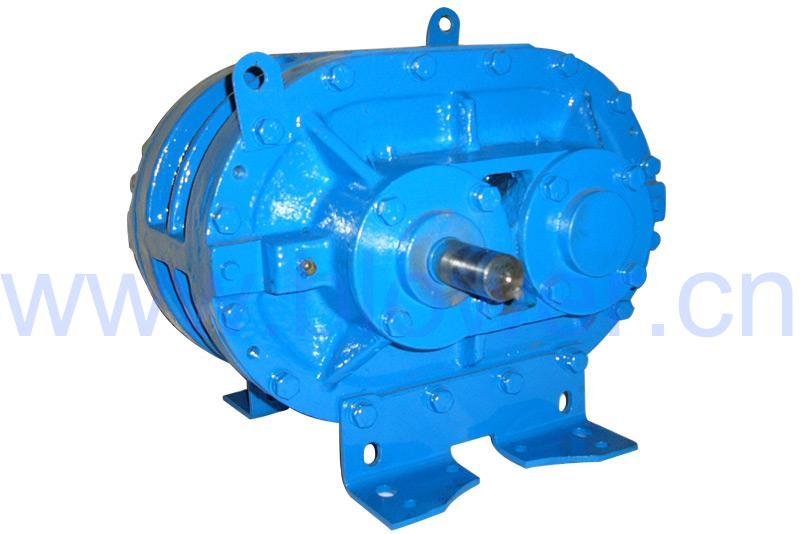
Pre Start Checks Should Be Mechanical and Electrical
Reading the manual is only the beginning. Before the first Roots blower startup, site teams should convert instructions into a visible checklist. Mechanically, all fasteners, positioning bolts, anchor bolts, supports, ducts, and valves should be checked. The rotor should be turned by hand or lever to confirm smooth movement without rubbing, jamming, or abnormal sound.

Lubrication is equally important. The main and auxiliary oil tanks should be filled to the specified oil center line, and upper and lower oil covers should be fastened to prevent leakage. For routine maintenance, guidance highlights a first oil change after 500 operating hours and subsequent oil changes every 4,000 operating hours. If a cooling unit is installed, water supply, temperature, and flow should be confirmed before operation.
Electrically, the control cabinet must match the blower in power, voltage, actuation method, and control mode. Cabinet terminal numbers should correspond to blower terminal numbers. The motor rotation direction must also match the blower’s indicated direction to prevent reverse rotation and possible impeller collision.
Startup and Shutdown Must Control Pressure Shock
The recommended Roots blower startup sequence is simple but important:
- Confirm the environment is suitable and instruments are working.
- Open the discharge valve and blower outlet valve.
- Start the blower and allow it to reach normal operation.
- Slowly close the vent or discharge valve while observing pressure, sound, vibration, and current.
In many wastewater aeration systems, pressure rises gradually to about 0.04–0.05 MPa. If pressure rises abnormally, or if vibration and noise increase sharply, the blower should be stopped for inspection.
Shutdown should be just as controlled. First, slowly open the vent valve to release pressure. Then close the outlet valve. Finally, cut power and allow the Roots blower to stop. This sequence reduces sudden pressure impact on the blower and connected piping.
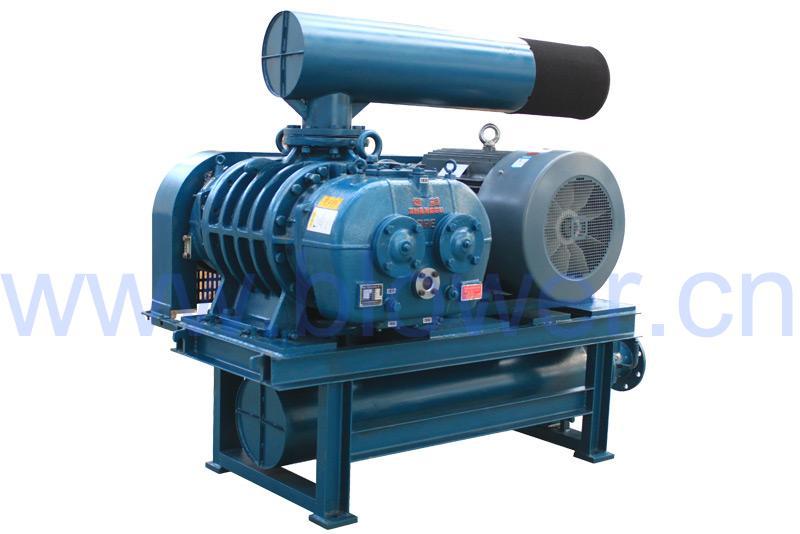
Early Operation Signals Reveal Hidden Problems
After commissioning, routine inspection should focus on trends rather than isolated readings.
| Signal | On-site focus |
|---|---|
| Oil level | Recheck after startup and investigate abnormal oil loss. |
| Vibration | Measure front and rear bearing housings in vertical, horizontal, and axial directions. |
| Sound | Listen for regular operating sound and inspect abnormal noise promptly. |
| Temperature | Check bearing housings, casing, and motor bearings. |
| Motor current | Stop and inspect if current increases significantly. |
| Pressure | Confirm pressure rises smoothly from startup to stable operation. |
Excessive temperature may be related to a dirty inlet filter, high inlet temperature, blocked ventilation of a soundproof cover, excessive oil level, overly viscous oil, or overload. Abnormal noise may point to belt alignment, bearing damage, or contact between rotor and casing.
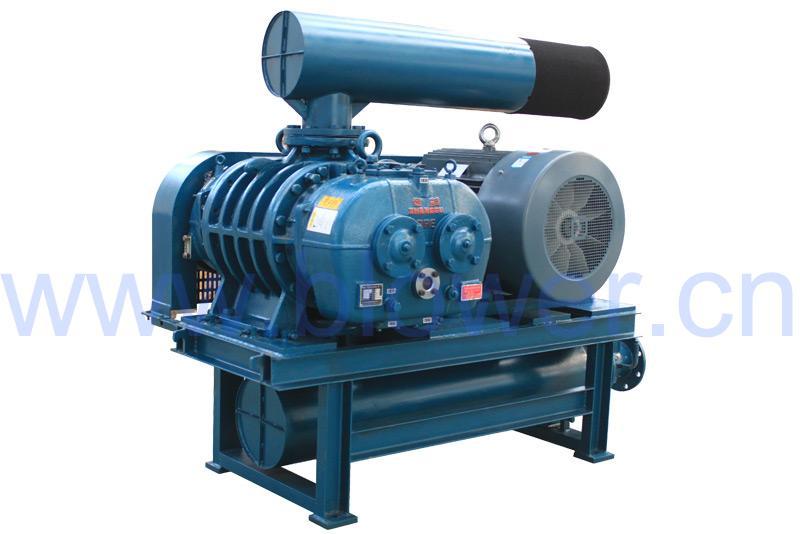
Where Selection Details Still Matter
In industrial wastewater treatment and zero discharge projects, Roots blowers and pneumatic conveying Roots blowers are also used. Drive selection should reflect site conditions. High-temperature environments often favor direct-coupled arrangements because belts may slip or break under heat. In high-static-electricity conditions, ordinary belts should be avoided; beryllium bronze belts or direct-coupled designs may be considered.
FAQs
Q1: Why is reading the manual not enough for Roots blower commissioning?
Because site checks must confirm alignment, pipe support, wiring, grounding, lubrication, rotation direction, and debris removal in the actual installation environment.
Q2: What does natural fit mean during installation?
It means the blower, foundation, and duct connections align without forced pulling, which helps reduce residual stress, vibration, and leakage.
Q3: Which pre-start item is most often overlooked?
Independent duct support is often underestimated. Duct weight should not be carried by blower parts.
Q4: Why should the vent valve be closed slowly after startup?
Slow closure allows pressure to rise gradually and helps avoid sudden overload, abnormal noise, and trip protection.
Q5: What should operators monitor after the first startup?
Oil level, vibration, sound, temperature, motor current, and pressure should be recorded and compared during early operation.
References
- Shandong Zhangqiu Blower Co., Ltd. (2019). Installation safety precautions for Roots blowers used as wastewater treatment aeration fans. https://www.blower.cn/new_details/1651030425375301632.html
- Shandong Zhangqiu Blower Co., Ltd. (2019). Maintenance of Roots blowers used as wastewater treatment aeration fans. https://www.blower.cn/new_details/1651030429682851840.html
- Shandong Zhangqiu Blower Co., Ltd. (2019). Noise treatment, maintenance standards, startup and shutdown of Roots fans. https://www.blower.cn/new_details/1651030425022980096.html
- Shandong Zhangqiu Blower Co., Ltd. (2019). Industrial wastewater treatment pneumatic conveying Roots blower. https://www.blower.cn/new_details/1651030439057121280.html
- Shandong Zhangqiu Blower Co., Ltd. (2019). Aeration blowers for industrial wastewater treatment and water reuse. https://www.blower.cn/new_details/1651030741908369408.html


