


Stop Cement Baghouse Trips by Fixing Your Air System First
Cement plants rarely lose uptime because of “one bad fan” or “one tired blower.” Most unplanned baghouse outages, unstable draft, and fast blade erosion come from an air system that was never sized and protected as a single package. At Shandong Zhangqiu Blower Co., Ltd., we recommend designing the HL618 screw blower together with a wear-resistant induced draft fan—so conveying air, kiln aeration, and dust collection draft work in the same direction instead of fighting each other.

Why a coordinated blower-and-fan package matters in cement service
In complex cement and dedusting lines, the HL618 screw blower is typically assigned to medium–small flow, higher-pressure duties—while the induced draft fan is expected to pull hot, dust-laden gas through preheaters, kilns, coolers, and the baghouse. When these units are selected separately by different vendors, three critical problems often emerge:
Energy waste from oversizing or constant throttling instead of precise speed control, leading to inflated operational costs.
Draft instability that triggers sensitive baghouse trips or causes damaging process swings, disrupting the kiln thermal profile.
Accelerated abrasion on impellers and casings from abrasive clinker, limestone, and fly ash, shortening the lifespan of critical components.
A coordinated HL618 screw blower plus wear-resistant induced draft fan package from us is built to reduce those conflicts significantly. With VFD-ready control concepts, you can maintain negative pressure exactly where it’s needed and still keep the air supply stable when production rates change. Backed by our 50+ years of experience in blower design and manufacturing, we ensure these systems communicate effectively within your process logic.
The HL618 screw blower: Stable, oil-free high-pressure air
The HL618 screw blower is designed specifically for harsh industrial conditions where you need a compact footprint, reliable pressure, and clean air delivery. For cement-related applications, the oil-free compression chamber is especially valuable because it reduces the risk of contaminating downstream equipment and helps keep aeration and conveying more predictable. Unlike traditional Roots blowers, the screw profile offers higher efficiency and lower noise, making it a superior choice for modernizing plants.

Typical operating window for the HL618 screw blower (range):
Flow: approximately 9.05–74.8 m³/min
Discharge pressure: approximately 34.5–248.2 kPa
Shaft power: approximately 11.9–230 kW
Compression chamber: 100% oil-free for air purity
Cooling: Air-cooled single stage (no water infrastructure required)
Where our customers most often apply the HL618 screw blower in cement plants:
Kiln or calciner aeration where stable pressure is critical for combustion.
Dense-phase or dilute-phase pneumatic conveying for moving raw meal or cement powder.
Silo and baghouse support aeration to reduce material compaction and improve discharge flow.
Sizing the HL618 screw blower without costly “insurance oversizing”
To select an HL618 screw blower that performs well over the full operating year, we focus on the real system losses rather than just the headline pressure rating. Our engineering team evaluates:
Total pressure head: We calculate pipeline losses, valve restrictions, filter resistance, and elevation changes.
Control method: We recommend VFD control when loads vary, which is typical in cement production.
Inlet protection: We specify filtration or pre-separation to keep large particles out of the precision screw stage.
Installation realities: We account for space constraints, noise requirements, and foundation vibration limits.
This meticulous approach keeps the HL618 screw blower efficient, preventing it from running permanently in a high-power “margin zone” that wastes electricity and stresses the motor.
The wear-resistant induced draft fan: Built for abrasive cement dust
A wear-resistant induced draft fan in cement duty faces a brutal environment. It must survive continuous impact erosion and sliding abrasion—often at elevated temperatures and with dust deposits that can drive imbalance and vibration. Standard fans simply cannot withstand the particulate loading found in clinker coolers or preheater exhausts.
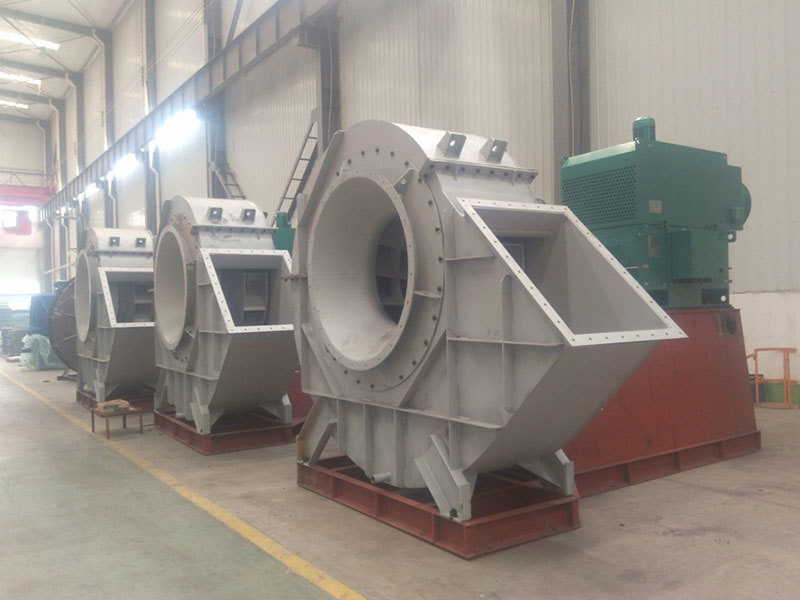
Our high-wear induced draft fan is engineered for typical cement gas paths such as:
Kiln and preheater exhaust
Clinker cooler extraction
Baghouse and cyclone dust collection
Material handling dedusting systems
Common field failure patterns we design around include leading-edge erosion, scroll wear near the cut-off region, inlet cone damage, and localized deposits that load bearings and seals. A properly specified wear-resistant induced draft fan reduces emergency repairs and makes planned shutdowns more predictable. We utilize advanced CAE software and our proprietary SiPESC platform to simulate particle trajectories and optimize the fan geometry for maximum life.

Wear protection choices that match your actual dust and uptime targets
Not every line needs the same protection concept. The right combination depends on dust hardness, particle velocity, temperature, and how long you need to run between planned stops. We tailor the solution to your specific maintenance cycle.
| Wear approach | Best used for | What to expect | Service note |
|---|---|---|---|
| Hardfacing (alloy surfacing weld) | General blade and casing protection | Solid wear life and good temperature tolerance | Field repairable; impeller must be dynamically balanced after work |
| Ceramic inserts / tiles | Severe abrasion zones (leading edges, cut-off) | Very high abrasion resistance | Higher upfront cost; attachment and thermal stress need careful design |
| Thermal-spray / HVOF coatings | Thin protection on complex profiles | Good for high tip speeds | Requires strict surface preparation and controlled shop process |
| Replaceable liners / plates | Inlet cone, volute scroll, outlet bend | Predictable “sacrificial” wear | Fast change-out during planned shutdowns |
In many of our successful cement projects, the best result comes from combining methods—for example, hardfaced blades plus targeted ceramic on leading edges and replaceable liners in the volute. This hybrid approach balances cost with extreme durability.
Two practical snapshots from cement and dedusting retrofits
Snapshot A: Draft stability and baghouse uptime
Challenge: A plant faced unstable negative pressure and frequent impeller repair due to abrasive dust loads.
Upgrade: We installed a correctly sized HL618 screw blower for stable aeration support, coupled with a VFD-ready wear-resistant induced draft fan featuring targeted ceramic wear parts.
Outcome: Fewer pressure swings and longer inspection intervals were achieved once the draft and air supply were aligned, leading to a 15% reduction in unplanned maintenance.
Snapshot B: Conveying line modernization
Challenge: An older blower was running at its limit, creating high noise levels and rising energy consumption.
Upgrade: We replaced it with an HL618 screw blower specifically selected for the required conveying pressure and implemented a wear-protected fan for the central dust collection system.
Outcome: The plant experienced fewer blockages, smoother maintenance planning, and improved operating consistency, with a noticeable drop in noise levels.
Engineer’s data checklist before we finalize the package
To specify the HL618 screw blower and the wear-resistant induced draft fan as one coordinated solution, our engineering team will typically confirm the following data points with you:
Required air/gas volume and total pressure differential (including system losses).
Gas temperature at blower and fan positions to select appropriate materials.
Dust concentration, hardness, and particle size distribution for wear analysis.
Target continuous runtime between planned stops (e.g., matching kiln campaigns).
Layout constraints (space, noise, foundations) to ensure seamless integration.
Why Choose Shandong Zhangqiu Blower?
As a company listed on the Shenzhen Stock Exchange (Stock Code: 002598) with over 50 years of manufacturing excellence, we are not just equipment suppliers; we are system integrators. We operate a 430,000 m² modern industrial park and have established joint ventures with Japanese partners and a branch in the USA. Our commitment to "Do the best" drives us to provide solutions like the HL618 screw blower and wear-resistant induced draft fan that truly solve customer pain points.
FAQs
Q: Is the HL618 screw blower oil-free for cement duty?
A: Yes. The HL618 screw blower uses an oil-free rotor chamber. However, proper inlet filtration and piping design are still essential to maintain air purity.
Q: When do you recommend ceramics instead of hardfacing on a wear-resistant induced draft fan?
A: When dust hardness and particle velocity are high enough that weld surfacing wears too quickly, ceramics are typically the better long-interval choice, despite the higher initial investment.
Q: Can the HL618 screw blower and wear-resistant induced draft fan be supplied with VFD-compatible drives?
A: Absolutely. VFD-ready motors and matching control concepts are commonly used to handle load swings and reduce energy waste, aligning with our Level 1 energy efficiency standards.
Next step for a cement line audit and sizing
If your goals are fewer baghouse trips, longer fan life, and lower lifecycle cost, start by treating the air system as one package. We can review your operating data and propose a coordinated HL618 screw blower and wear-resistant induced draft fan configuration, including a practical wear-protection plan.
Contact us to request sizing support


