


Rethink FGD Fan Selection Before Corrosion and Leaks Cost You Downtime
In corrosive FGD and chemical scrubber systems, real reliability comes from matching fan materials, corrosion resistance and sealing reliability to hot, wet, acidic operating conditions rather than only nameplate flow and pressure.
Flue gas desulfurization (FGD) and chemical scrubber systems typically subject fans to hot, wet, dusty, and highly acidic gases. In such harsh environments, relying merely on nameplate flow and pressure is just the starting point. True equipment availability hinges on whether the fan's materials, surface protection, and sealing arrangements can withstand the actual gas chemistry over years of continuous operation.
With over five decades of dedicated R&D and manufacturing expertise, we at Shandong Zhanggu understand these challenges intimately. Our portfolio includes direct-drive single-stage high-speed centrifugal blowers, process-gas stainless steel high-speed fans for corrosive media, and SSR / SSR-N series Roots blowers. Building upon this foundation, we believe that FGD fan selection and chemical scrubber fan selection must be framed around corrosion resistance and sealing reliability instead of just focusing on flow and pressure.

Operating Conditions That Should Drive FGD Fan Decisions
Actually, before finalizing any FGD fan selection or chemical scrubber fan selection, it's crucial to map out the exact process conditions. You really need to clarify:
Gas composition, including SO₂ and other aggressive acid gases
Typical and extreme temperatures experienced during start-up and shutdown phases
Humidity levels and dew-point behavior
Particulate loading, such as fly ash or gypsum crystals
Duty cycle, load-following modes, and bypass or standby operation expectations
These elements dictate the specific corrosion, erosion, and fouling mechanisms the fans will inevitably encounter in FGD and scrubber operations. When your specifications capture this vital information up front, fan types, materials, and sealing concepts can be accurately tailored to match the actual environment, rather than an idealized clean-gas scenario.
Matching Fan Technologies to Desulfurization Service
Various fan technologies utilized within an FGD or chemical scrubber system endure distinct mechanical stresses, requiring specialized anti-corrosion and sealing concepts. Our product families provide several field-proven options to meet these demands.
Centrifugal Fans for Flexible Pressure and Flow
According to our centrifugal fan data, typical capabilities include:
Flow capacities ranging from 1–800 m³/s
Pressure capabilities from 300–50,000 Pa
"Tailor-made" selection approaches to perfectly match the duty point
Multiple control options, including inlet guide vanes, dampers, belt or gearbox drives, couplings, and variable-frequency operation
Flat performance curves that provide a broad high-efficiency zone
Optional wear-resistant, high-temperature-resistant, and corrosion-resistant structures depending on the specific medium
Applying these centrifugal designs to FGD fan selection means we stick to our tailor-made philosophy, placing extra emphasis on materials that genuinely resist wet, acidic, and particle-laden environments.
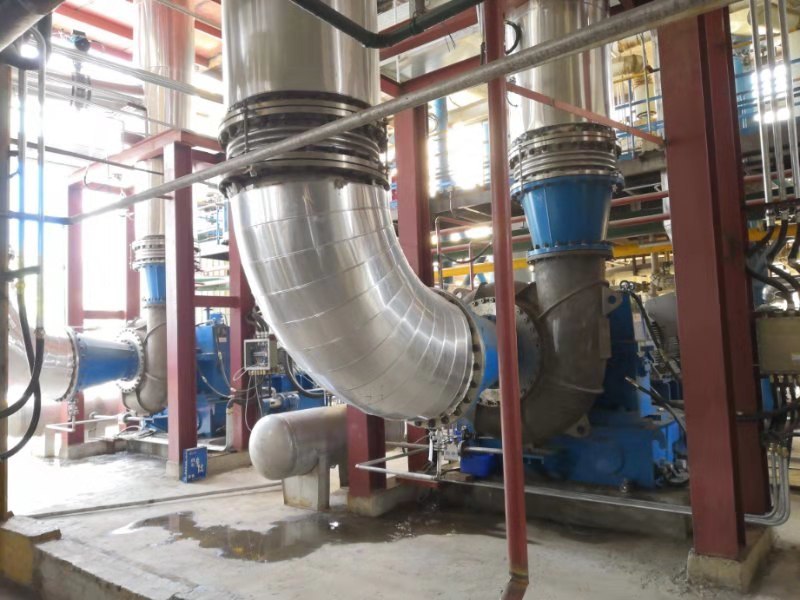
For instance, the single-stage high-speed centrifugal blower shown above was specifically redesigned to slash energy consumption and overall operating costs. This type of high-efficiency, compact blower is exceptionally well-suited to dense, dusty gas streams when combined with appropriate wear- and corrosion-resistant measures.
Axial Fans for Very High Flow FGD and Scrubber Systems
For extremely large volumes at moderate pressure, adjustable-blade axial fans are often the preferred choice. Our axial fan characteristics include:
Flow capacities from 30–1,800 m³/s
Pressure capabilities from 900–19,000 Pa
"Tailor-made" selection for every unique application
Adjustable moving or stationary blades paired with optional variable-frequency control
Flat performance curves maintaining a broad high-efficiency region
Utilization of specialized wear-resistant and corrosion-resistant materials and structures according to the transported medium
In FGD and chemical scrubber services, these features empower the fan to seamlessly adapt to changing system resistance while maintaining peak efficiency. Simultaneously, blade and hub materials can be purposefully selected for the corrosive, droplet-rich environment inside absorber and duct systems, significantly enhancing scrubber blower corrosion resistance.
Roots Blowers Where Stable Differential Pressure is Critical
Our SSR and SSR-N Roots blowers are utilized when relatively high differential pressure, stable flow, and compact footprints are mandatory. For our N series three-lobe Roots blower, the main technical indices are:
Port size: DN80–200
Pressure: 9.8–98 kPa
Flow: 4.5–70 m³/min
Meanwhile, the VN series covers:
Port size: DN80–200
Pressure: −9.8–49 kPa
Flow: 4.4–69.5 m³/min
Design features directly supporting fan sealing reliability and extended operational life include:
High-speed, high-efficiency rotor profiles
Premium imported bearings perfectly suited for high-temperature, continuous duty
Piston-ring-type shaft seals that offer superior sealing effects and higher volumetric efficiency
An integrated base and discharge silencer for compact installation and streamlined maintenance
Full-flow safety valves at the discharge to guarantee robust overload protection
Air-cooled construction easily handling single-stage pressure up to 98 kPa without the need for water cooling
In and around FGD and scrubber systems, these positive-displacement blowers really shine where stable flow and tight sealing are absolute necessities, such as in auxiliary gas handling or reagent systems.
Materials, Linings, and New Materials Thinking
Our extensive field experience indicates that FGD fan selection yields far better outcomes when you treat scrubber blower corrosion resistance as a long-term lifecycle investment rather than a short-term cost to minimize.

Our process-gas stainless steel high-speed fan has been successfully deployed in corrosive gas media such as SO₂ and dilute nitric acid, operating flawlessly at pressure ratios above 2.5. Recent success stories include an SO₂ fan with a pressure ratio of 2.56 and two dilute nitric acid fans boasting pressure ratios of 2.52. These projects clearly demonstrate how high-pressure stainless steel fans can be expertly engineered for aggressive gases when composition and temperature are clearly defined.
Beyond fans, we have also developed a highly durable ceramic slurry pump within our new-materials lineup. Featuring high-temperature sintered ceramic overcurrent parts, it delivers a wear life up to three times that of traditional wear-resistant metals, actively helping concentrator plants reduce operational costs and unplanned downtime.

This exact same materials-focused mindset can greatly support your chemical scrubber fan selection. By combining robust stainless steels, special structures, hardfacing, or engineered linings in high-risk zones, you often achieve a significantly better whole-life cost compared to constantly replacing low-grade components exposed to wet, acidic gases.
Sealing, Bearings, and Fan Sealing Reliability
When dealing with corrosive, particle-heavy gases, fan sealing reliability impacts your system's uptime just as much as the core impeller design. Our Roots blowers beautifully illustrate several highly effective design patterns:

Piston-ring shaft seals securely positioned at the shaft ends deliver outstanding sealing performance, effectively keeping acidic or dusty gas far away from the bearing housings.
Imported bearings are meticulously selected to withstand high temperatures and continuous operation, safely supporting an extended design life.
Full-flow safety valves at the discharge act as a vital safeguard, protecting the machine during sudden system upsets or blockages.
Air-cooled structures cleverly avoid water-cooling circuits and their inherent leakage risks, all while still achieving up to 98 kPa in a single stage.
When we transfer these innovative concepts to centrifugal and axial fans for FGD and scrubber duties, they act as an insurance policy—ensuring that corrosion, leakage, and premature bearing failures do not undermine an otherwise stellar hydraulic design.
Practical Checklist for FGD and Scrubber Fan Specifications
To ensure your FGD fan selection and chemical scrubber fan selection stay focused on real-world operating demands rather than just theoretical nameplate duties, we recommend using this practical checklist when engaging with vendors:
| Item | What to define for vendors |
|---|---|
| Flow & pressure | Minimum, normal, and maximum operating points; start-up and upset conditions |
| Gas composition | SO₂ and other acid gases, oxygen, expected condensate, and impurities |
| Temperatures | Normal temperature range, start-up and shutdown extremes, reheating strategy |
| Solids loading | Fly ash, gypsum, slurry, or droplet carryover levels |
| Fan type | Centrifugal, axial, or Roots, along with expected operating window and control mode |
| Materials | Casing, impeller, or rotor alloys; any upgraded materials required for high-risk areas |
| Linings/coatings | Specific type and thickness where required, plus strict temperature limits |
| Seals | Shaft seal type, materials, and strict leakage limits in the actual gas environment |
| Bearings | Bearing type, expected operational life, and robust protection against gas or particulate ingress |
| Maintainability | Inspection openings, liner replacement access, and an efficient seal maintenance approach |
Leveraging this structured approach encourages suppliers to explicitly address scrubber blower corrosion resistance and sealing design, rather than simply handing over a generic fan sized only for flow and pressure.
How We Support Application-Specific Fan Design
Since our founding in 1968, we at Shandong Zhanggu (Shandong Zhangqiu Blower Co., Ltd.) have dedicated ourselves to advancing industrial fan engineering. Today, our comprehensive product range covers:
Centrifugal fans and robust blowers
Roots blowers, prominently featuring the SSR and SSR-N series
High-speed fans, such as single-stage centrifugal blowers and process-gas stainless steel high-speed fans
MVR steam compressors and advanced environmental water-treatment equipment
Innovative new-materials products, including our highly successful ceramic slurry pumps
Our continuous lean-management initiatives and aggressive new-product development have remarkably improved production efficiency, fueling rapid growth in our high-speed fan sales. This profound depth of experience gives us a highly practical foundation when you need to perfectly align fan technology, materials, and sealing concepts with unforgiving FGD and scrubber conditions.
Contact Us for Engineering Support
For dedicated engineering support regarding FGD fan selection, chemical scrubber fan selection, and application-specific fan solutions, you can contact us at Shandong Zhanggu:
Service phone: 0531-83250025
Email: wxb@blower.cn
Address: Shandong Zhangqiu Blower Co., Ltd., Ming Shui Economic Development Zone, Century Avenue East, Zhangqiu District, Jinan, Shandong Province
Online consultation: click here to consult online
FAQs
Q1: Why shouldn't FGD and scrubber fan selection rely solely on flow and pressure?
In wet, hot, and acidic gas environments filled with solids, flow and pressure only size the fan hydraulically. Materials, surface protection, sealing, and bearing design ultimately determine whether the fan can survive severe corrosion, erosion, and fouling over many years. Ignoring these crucial factors often leads to dangerous leaks, bearing failures, and highly disruptive unplanned outages.
Q2: When should centrifugal, axial, and Roots fans be considered around desulfurization systems?
Centrifugal fans efficiently cover a wide range from low to high pressure with highly flexible control options, making them perfectly suitable for many FGD and scrubber duties. Axial fans are deployed where very high flow and moderate pressure are needed, especially taking advantage of adjustable blades. Roots blowers, such as our SSR-N and VN series, are strictly preferred where stable differential pressure and highly accurate sealing are critical.
Q3: How do we handle highly corrosive gas media in high-pressure applications?
We have developed specialized process-gas stainless steel high-speed fans that have been successfully utilized in SO₂ and dilute nitric acid service at pressure ratios well above 2.5. Recent orders, such as an SO₂ fan with a pressure ratio of 2.56 and dilute nitric acid fans with pressure ratios of 2.52, prove that deploying appropriate materials and structural measures can handle aggressive gases incredibly reliably.
Q4: What specific design features help improve fan sealing reliability in FGD and scrubber service?
Features beautifully illustrated by our SSR-N Roots blower include robust piston-ring shaft seals, imported bearings designed for high-temperature continuous duty, integrated bases complete with discharge silencers, full-flow safety valves, and efficient air-cooled construction. These exact same concepts can and should be specified for centrifugal and axial fans working in corrosive, particle-laden gases.
Q5: Can new-materials technology, such as ceramics, actually help in desulfurization projects?
Absolutely. Our ceramic slurry pump, which utilizes high-temperature sintered ceramic overcurrent parts, achieves a wear life several times greater than that of traditional wear-resistant metals. This prime example clearly illustrates how advanced materials can drastically extend service life in the abrasive, chemically aggressive conditions routinely found around FGD and related processes.


