


Multistage Blower Pressure Decides 50000 m3 Aeration Results
For a sewage treatment plant handling 50,000 m³ per day, aeration blower selection is not a secondary equipment decision. From our experience, when the aeration system is configured with four multistage centrifugal blowers, the match between discharge pressure, efficiency, regulation range, and basin depth directly affects dissolved oxygen supply, biological activity, and final treatment quality.

Why Aeration Blower Pressure Matters
In biological wastewater treatment, the aeration blower sends air through pipelines to the bottom of the treatment tank. Oxygen then dissolves into the mixed liquor, allowing aerobic microorganisms to metabolize suspended solids, dissolved organic matter, nitrogen, phosphorus, and other pollutants. Aeration also supports gas–liquid mass transfer and provides mixing that keeps biological activity evenly distributed.
Typical wastewater aeration basins require a water depth of 7–8 meters. To overcome this depth and deliver air through the diffuser system, the blower outlet pressure generally needs to reach the equivalent of 7–9 meters underwater. This is why a multistage centrifugal blower used in this duty is commonly described by four practical requirements: relatively small flow per unit, high pressure, high efficiency, and a wide adjustment range.
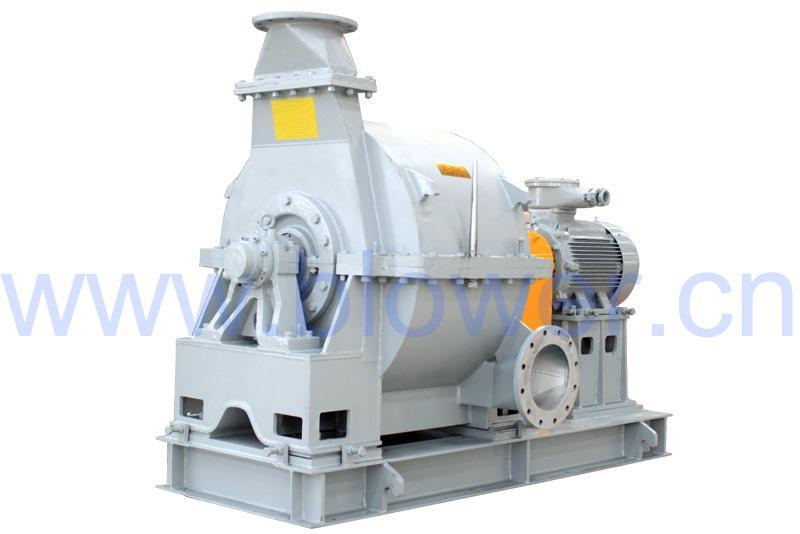
If pressure is too low, air delivery at the tank bottom becomes unstable and oxygen supply may be insufficient. If the blower is oversized or operates far from its efficient region, power consumption rises and long-term operation becomes less economical. For a 50,000 m³ per day plant, these differences accumulate quickly because aeration runs continuously.
Why Four Multistage Centrifugal Blowers Are Common
A documented configuration for a 50,000-ton-per-day sewage treatment plant is four multistage centrifugal blowers. Splitting the duty across four units gives operators more flexibility than relying on one or two large machines. It also helps match airflow to process demand while maintaining operational continuity during maintenance.
Multistage centrifugal blowers compress air through several impellers in series. In wastewater aeration, this structure is suited to higher outlet pressure requirements while keeping noise, vibration, wear, and lifecycle cost under control. These characteristics make the multistage centrifugal blower a strong fit for medium-scale sewage treatment plants in the 30,000–100,000 m³ per day range.
Comparing Main Aeration Blower Options
| Blower type | Typical strengths | Key selection note |
|---|---|---|
| Roots blower | Simple structure, low maintenance workload, suitable for small air flow and variable liquid level | In constant-pressure aeration, efficiency is more than 10% lower than centrifugal blowers |
| Single-stage high-speed centrifugal blower | Flow adjustment range of 45%–100%, higher efficiency at similar outlet pressure | Higher speed brings more noise, more complex structure, and higher replacement cost |
| Multistage centrifugal blower | Higher pressure capability, high efficiency, convenient regulation, low noise, low vibration, long service life | Well matched to 7–9 m aeration pressure in medium-scale plants |

Roots blowers remain widely used in small town wastewater treatment plants because they are compact, simple, and economical to maintain. However, in deeper constant-pressure aeration systems, the energy difference compared with centrifugal equipment becomes more important.
Single-stage high-speed centrifugal blowers are positioned for municipal sewage treatment plants, waterworks, and industrial wastewater users pursuing stronger energy-saving performance. Their efficiency is described as about 3%–5% higher than multistage centrifugal blowers and about 15%–20% higher than Roots blowers under comparable outlet-pressure conditions.
Efficiency Supports Deep Treatment and Reuse
Modern wastewater projects increasingly connect aeration performance with deep treatment, reclaimed water reuse, and zero-discharge goals. In these applications, the aeration blower must not only provide oxygen, but also support stable operation under changing loads.
High-efficiency centrifugal equipment listed for environmental applications includes designs with 91% efficiency, 60000–80000 m³/h flow, 6000–9500 Pa total pressure, and vibration at or below 2.5 mm/s. Features such as covered casings, broad flow regulation, wide high-efficiency zones, and stable operation are especially relevant where energy saving and low noise are procurement priorities.
As a blower manufacturer, our SiPESC series high-efficiency energy-saving centrifugal fans are designed along these lines. Based on the SiPESC CAE platform, we established accurate digital simulation models and optimized the fan structure with special solvers. With a new bearing box design, imported bearings, and high-strength steel plates, the series achieves efficiency up to 91%, flow 60000–80000 m³/h, total pressure 6000–9500 Pa, and vibration ≤ 2.5 mm/s, while maintaining low noise and reliable, stable operation.
For deep treatment, reuse, and zero-discharge projects, such multistage and centrifugal blower solutions help plants reduce specific energy consumption while keeping noise and vibration within strict environmental limits.

Practical Selection Priorities
For a 50,000 m³ per day wastewater treatment blower system, the first priority is confirming the 7–8 m basin depth and specifying outlet pressure for 7–9 m underwater aeration. The second priority is keeping each multistage centrifugal blower within an efficient operating range instead of selecting capacity only by maximum demand.
Plant owners should also compare noise, vibration, control range, maintenance requirements, and redundancy. When four multistage centrifugal blowers are selected correctly, they can support stable biological treatment while leaving room for future deep treatment or reuse upgrades.
Talk to Our Engineering Team
If you are planning or upgrading a 30,000–100,000 m³ per day wastewater treatment plant and need support on aeration blower selection, our engineering team can help size and configure the multistage centrifugal blowers to match your basin depth, diffuser system, and energy targets. You can reach us through the contact form on our website: online inquiry.
FAQs
Q1. Why is 7–9 m pressure important for aeration blowers?
Because wastewater aeration basins commonly reach 7–8 m water depth, the blower must provide enough outlet pressure to deliver air to the tank bottom and maintain oxygen transfer.
Q2. Why does a 50,000 m³ per day plant often use four blowers?
A typical documented arrangement uses four multistage centrifugal blowers, helping balance flow distribution, operational flexibility, and maintenance continuity.
Q3. When are Roots blowers more suitable?
Roots blowers are often used in small wastewater treatment plants and variable liquid-level systems, especially where simple structure and lower maintenance cost are priorities.
Q4. What makes multistage centrifugal blowers suitable for this duty?
They offer higher outlet pressure capability, high efficiency, convenient adjustment, low noise, low vibration, low wear, and long service life.
Q5. How do single-stage high-speed centrifugal blowers compare?
They can provide a 45%–100% flow adjustment range and higher efficiency, but their higher speed is associated with more noise, more complex structure, and higher replacement cost.
References
- 山东省章丘鼓风机股份有限公司. (2019). 多级离心鼓风机:曝气风机的升级版,助力废水深度处理. https://www.blower.cn/new_details/1651030429779320832.html
- 山东省章丘鼓风机股份有限公司. (2019). 山东中水回用:工业废水治理 废水零排放曝气鼓风机显神威. https://www.blower.cn/new_details/1651030741908369408.html
- 山东省章丘鼓风机股份有限公司. (2019). 污水处理曝气风机之罗茨鼓风机保养与维护. https://www.blower.cn/new_details/1651030429682851840.html
- 山东省章丘鼓风机股份有限公司. (2019). 污水处理曝气风机之罗茨鼓风机安装安全注意事项. https://www.blower.cn/new_details/1651030425375301632.html
- 山东省章丘鼓风机股份有限公司. (2023). 山东章鼓携明星产品亮相第24届中国环博会!. https://www.blower.cn/news/376.html
- 山东省章丘鼓风机股份有限公司. SiPESC系列高效节能离心通风机技术资料.


